
Block Paving Support
Our block paving support section is designed to help you get the best results from your Brett products, from delivery through to installation and early life care. As our paving is manufactured using natural materials and produced in line with British Standards, some variations and on-site considerations are to be expected.
The guidance below outlines common characteristics such as colour variation, efflorescence, and minor imperfections, along with industry-accepted tolerances and installation best practices to ensure a high-quality, long-lasting finish.

At Brett Landscaping, we take pride in the quality of our products which are manufactured using naturally extracted raw materials like aggregates, pigments, and cement. We use premium naturally occurring granite aggregates to manufacture some of our products such as Invicta & Lugano Block paving, Meltone Kerb, Trief & Kassel Kerb undergo secondary processes like shot blasting to achieve their final appearance.
We have several factory procedures in place to maintain consistency in shade, colour, and texture within and between batches. However, due to the natural materials and secondary processes involved, slight variations in the finished products are normal within and between batches. We believe that these variations enhance the character and natural beauty of the products.
- To ensure the best possible finish, we recommend following some guidelines to evenly distribute any slight variations in shade, colour, and texture over a large area. It’s best to complete one area of paving using products taken from the same batch.
- Regardless of whether your product is from the same batch or different batches, it’s essential to minimise possible colour banding/shading by mixing products from a minimum of three packs. Install product ‘slice by slice’ vertically down the pack rather than across each layer.
- We also recommend ordering all products at the same time, especially when purchasing larger quantities.
If you have followed the advice provided regarding batch checking and mixing products but still have unanswered questions, please contact our customer care team on 0345 60 80 577.
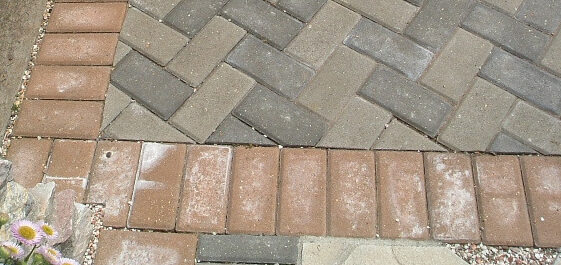
Efflorescence is a natural occurrence that can happen during the manufacturing and curing process of concrete products. This happens when a complex chemical reaction takes place between the cement, water, and carbon dioxide. It is a phenomenon that affects concrete products worldwide and is not specific to any one manufacturer. It’s important to note that efflorescence is a temporary occurrence and is not harmful to the product, people, or pets.
Typically, it can take up to 12 months for efflorescence to dissipate, although it may take longer in some cases. Please note that efflorescence is not a product defect. In the event that efflorescence occurs, it may temporarily obscure the colour of the product, but it will eventually be washed away by rain and natural weathering.
Please note that efflorescence is not a product defect and as such, Brett Landscaping does not offer product replacements for efflorescence. Therefore, we advise that you allow nature to take its course and the efflorescence to naturally dissipate.
All Brett Landscaping products are carefully inspected through the production process up to and including loading onto the delivery vehicle. During the process of loading, transporting, offloading, and on-site handling, it is inevitable that a few blocks may develop minor chips along their edges.
According to industry norms, it is considered acceptable for 2-5% of the total quantity to have such damage. These chipped blocks are typically suitable for cutting purposes and should be separated during installation. In cases where the percentage of chipped or damaged blocks exceeds 2-5%, they should not be installed and should be set aside for inspection by a Brett Representative.
Any defects must be reported without delay. If your product has arrived broken please contact our Customer Service team on 0345 60 80 577 who will be in touch to quickly resolve this.
Brett Landscaping strictly adheres to the relevant British Standards, BS EN 1338:2003, for the manufacturing and testing of their concrete paving blocks.
While it is uncommon, minor surface imperfections may occasionally occur in concrete products despite the implementation of modern techniques and factory inspections. Typically, these imperfect blocks are identified and removed at the factory. However, there may be instances where they go unnoticed during inspection and find their way to our customers. In the majority of cases, any products with minor surface imperfections are detected during installation, allowing them to be set aside and used for cut pieces.
If you receive a quantity of blocks with surface imperfections exceeding the industry standard of 2-5%, it is advised not to install them. Instead, set them aside for inspection by a representative from Brett Landscaping, and please consult your supplier for guidance. As a good practice, before adding the jointing material, the installer should conduct a final inspection and address any corrective measures by removing any blocks with surface imperfections that may have been missed during the installation process.
Brett Landscaping follows strict adherence to the relevant British Standards, BS EN 1338:2003, for the manufacturing and testing of their Concrete Paving blocks.
When Concrete Paving blocks are installed in direct contact with each other, known as butt jointing, there is a possibility of chipping occurring at the edges, this is known as spalling. To prevent spalling or chipping, it is essential to install Concrete block paving in line with BS 7533-3: 2005 + A1: 2009 recommends a typical joint width of between 2m to 5 mm. This joint width allows for the placement of the jointing sand within the joints. The jointing sand both transfers any load placed on the block to the adjacent blocks as well as maintaining the required space to stop block on block contact which causes chipping. The jointing material acts as a cushion between the blocks, minimising the risk of chipping/spalling.
Chipping can also happen when cut pieces are forcefully inserted during installation or when the joints are not adequately filled with jointing sand. It is important to ensure that any cut pieces are no smaller than 1/4 of a block and that the 2-5mm joint is maintained to prevent chipping. In cases where jointing material has been removed during cleaning, it is crucial to replace it to prevent chipping from occurring. Please note, the nibs on our block paving products are not a laying guide, please refer to our step-by-step guidelines for details on how to install block paving.
Brett Landscaping manufactures and tests all their concrete paving blocks in strict adherence to the applicable British Standards, specifically BS EN 1338:2003.
According to this standard, manufacturers are allowed certain dimensional tolerances for concrete paving blocks. These tolerances include a range of + or – 2mm in length and width, as well as + or – 3mm in thickness/height. As long as the blocks comply with these specified tolerances, they meet the criteria outlined in the standard and are considered suitable for their intended purpose.
During the inspection process at the factory, blocks are measured using verniers. This method ensures accurate measurements, as opposed to using a tape measure or ruler, which may not provide precise results. When installing concrete paving blocks, it is important to follow the guidelines stated in BS7533. This standard specifies that a joint width of 2-5mm should be maintained and correct screeding layer to accommodate any height variations. This allowance enables the installer to adjust and camouflage any minor discrepancies that may arise from manufacturing tolerances.
How to Install Concrete Block Paving
619 KB