Kerb Support
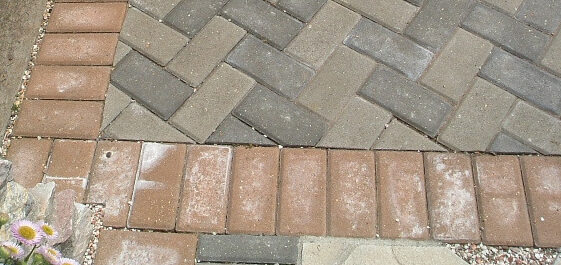
Efflorescence is a natural occurrence that can happen during the manufacturing and curing process of concrete products. This happens when a complex chemical reaction takes place between the cement, water, and carbon dioxide. It is a phenomenon that affects concrete products worldwide and is not specific to any one manufacturer. It’s important to note that efflorescence is a temporary occurrence and is not harmful to the product, people, or pets.
Typically, it can take up to 12 months for efflorescence to dissipate, although it may take longer in some cases. Please note that efflorescence is not a product defect. In the event that efflorescence occurs, it may temporarily obscure the colour of the product, but it will eventually be washed away by rain and natural weathering.
Please note that efflorescence is not a product defect and as such, Brett Landscaping does not offer product replacements for efflorescence. Therefore, we advise that you allow nature to take its course and the efflorescence to naturally dissipate.
All Brett Landscaping products are carefully inspected through the production process up to and including loading onto the delivery vehicle. Any defects or damage must be reported without delay. If your product has arrived broken please contact our Customer Service team on 0345 60 80 577 who will be in touch to quickly resolve this. Important: If products are installed despite clear defects that were noticeable before installation, the installer will be held accountable for all expenses associated with resolving the problem.
Cracking of Brett Landscaping kerbs in their installed position is highly uncommon. There are a couple of potential reasons for cracks to appear. One is the use of overly strong mortar for bedding and jointing, while another is the omission of movement/expansion allowances during the initial joining process. To ensure consistency in colour, texture, and dimensional tolerance, it is recommended to carefully sort the products. Any defects should be promptly reported.
If products are installed despite having noticeable defects before installation, the installer will bear the responsibility for all expenses associated with resolving the issue.
Another potential cause of cracking is the installation of kerbs with butt joints, where they are placed in direct contact with each other. This can lead to chipping, also known as spalling. For proper installation, kerbs and edgings should be laid with close joints ranging from 2 to 4mm, either without mortar or with wider joints of 5 to 10mm that are pointed with mortar. In cases where mortared joints are used, it is important to allow for expansion by excluding mortar from a joint every 15 meters.