-
- All
- British Standard
- Broadway Economy
- Chaucer
- Eclipse Porcelain
- Eden Limestone Porcelain
- Eden Sandstone Porcelain
- Elegante Quartz Porcelain
- GeoCeramica® Baltico Porcelain
- GeoCeramica® Fiordi Porcelain
- GeoCeramica® Impasto Porcelain
- Meltone
- Quorndon
- Rippled Limestone
- Riven Sandstone
- Tactile Paving
- Yorktone
- Pedestals
With pressure growing on drainage infrastructure and flood resilience becoming an increasingly important consideration for developers, should surface water management now be viewed as a fundamental part of hard landscaping design rather than a separate engineering challenge?
Across the UK, planners, local authorities and developers are placing greater emphasis on Sustainable Drainage Systems (SuDS) as part of the drive to create more resilient communities. Managing water at source is increasingly recognised as one of the most effective ways to reduce pressure on conventional drainage networks while supporting wider flood mitigation objectives.
Hard landscaping has a vital role to play in this process. Permeable paving systems are specifically designed to allow rainfall to infiltrate through joints in the surface and into a carefully engineered sub-base below. Rather than directing large volumes of water into drains and sewers, the system helps manage runoff naturally within the site itself.
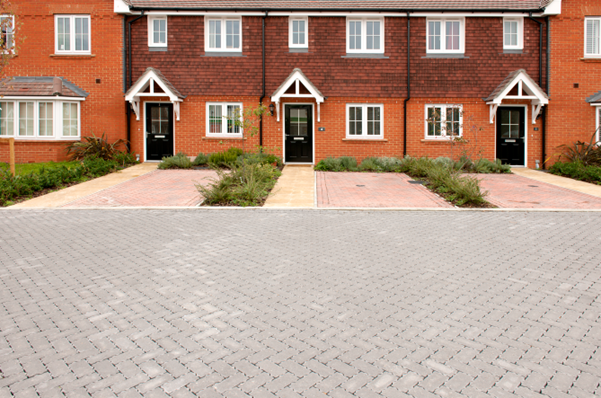
Importantly, specifying permeable paving does not require compromises on appearance or durability. The paving units themselves are manufactured using the same concrete technology as conventional block paving. The difference lies in the design of the overall system, which provides effective drainage while maintaining the strength and visual appeal expected from modern hard landscaping solutions. Our Flow range of block paving are all permeable products, such as Invicta Flow, Lugano Flow, Alpha Flow and Omega Flow.
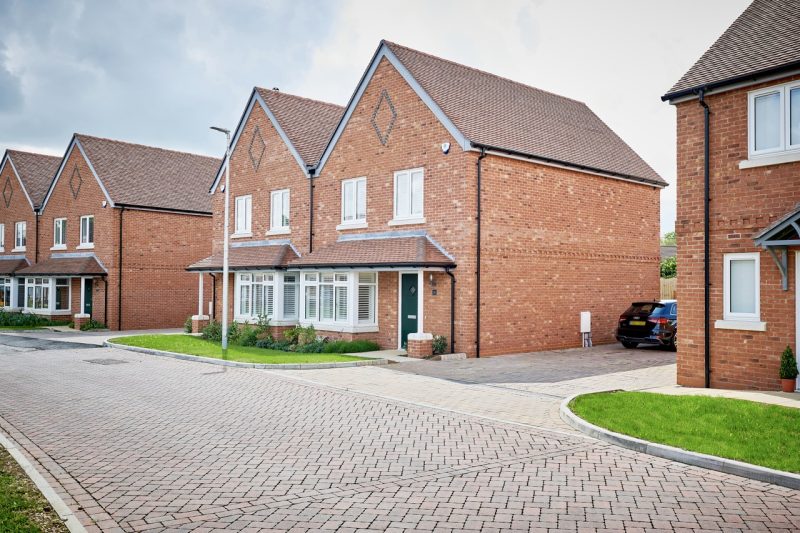
Alpha Flow, Brindle & Autumn Gold
This creates significant benefits for housing developments and mixed-use schemes. Developers can address planning and drainage requirements while continuing to deliver attractive and highly functional external environments. At the same time, permeable paving contributes to long-term operational performance by helping reduce standing water and ponding issues.
In areas such as car parks and access roads, conventional impermeable surfaces can sometimes develop depressions as a result of repeated vehicle movements and braking. These low spots often collect water, creating both maintenance and appearance challenges. Because permeable paving allows water to move through the surface rather than sit on top of it, the system can help mitigate these issues and improve overall resilience.
As sustainability targets become more ambitious and climate resilience moves further up the agenda, surface water management is no longer an optional consideration. By integrating SuDS principles into hard landscaping specification from the earliest design stages, developers can create projects that are better equipped to meet the environmental, operational and regulatory challenges of the future.
View the Brett Landscaping Permeable Paving Collection
By Jamie Gledhill, Engineering Technical Manager at Brett Landscaping and Building Products